Bio Musculo Index: What your muscle age actually is
A 48-year-old with the muscle biology of a 68-year-old will hurt like a 68-year-old. An X-ray will not show that. The Bio-Musculo Index is Dr. Ganguly's 35-year diagnostic: a 60+ marker blood panel that estimates muscle biological age and flags the metabolic problems that wear joints down. That is the information most workups never collect.
What is the Bio-Musculo Index?
The Bio-Musculo Index (BMI) is a scored blood panel Dr. Apurba Ganguly spent 35 years refining across 100,000+ cases. It is not the generic CBC your GP orders. It looks at muscle-specific markers: creatine kinase isoforms, cytokine patterns, oxidative-stress indicators, mitochondrial function, and cartilage-breakdown proteins. Read together, they describe the biology of your pain in a way a scan cannot.
Why scans are not enough
X-rays and MRIs show structure. BMI shows why the structure failed: the metabolic and cellular problems in muscle that imaging cannot measure.
Pattern-matching across 60+ markers
Software compares your 60+ markers — inflammation, oxidative stress, metabolism — against a large patient set and estimates muscle age from that pattern.
A plan tied to your numbers
The score points to which pathways are off — inflammation, energy production, cartilage turnover — so treatment is aimed at those, not at a generic diagnosis.
How BMI Testing
Simple Blood Draw
A standard blood sample is collected during your initial consultation. No fasting or special preparation required.
AI Analysis
Our proprietary AI algorithm analyzes 60+ biomarkers including inflammatory markers, oxidative stress indicators, mitochondrial function, and metabolic parameters.
Personalized Report
Within 48 hours, receive your detailed BMI report showing your muscle age, specific dysfunctions, and customized treatment protocol.
What Your BMI Report
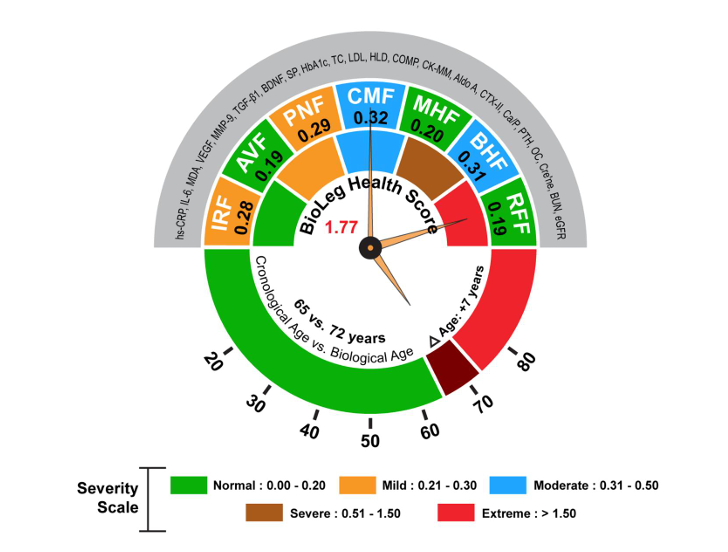
The report maps muscle age, inflammation, and the metabolic problems that keep joints sore.
Muscle Age vs Chronological Age
Discover if your muscles are aging faster than your actual age. A 50-year-old might have a muscle age of 65, explaining why they feel older and experience more pain.
Inflammatory Cascade Analysis
Identify specific inflammatory markers (IL-6, TNF-alpha, CRP) driving tissue damage and pain. This explains why some treatments work and others don't.
Oxidative Stress Profile
Measure cellular damage from free radicals (MDA, SOD, GPx). High oxidative stress accelerates muscle degeneration and cartilage breakdown.
Mitochondrial Function
Assess your cells' energy production capacity. Poor mitochondrial function means muscles can't repair themselves, leading to chronic degeneration.
Metabolic Dysfunction Markers
Identify insulin resistance, glucose metabolism issues, and hormonal imbalances affecting muscle health and pain levels.
Cartilage Degradation Indicators
Measure specific biomarkers (CTX-II, COMP) showing active cartilage breakdown in joints—critical for conditions like osteoarthritis.
Why BMI is clearer than a scan or a standard blood test
MRI/X-Ray Limitations
Shows structural damage but not the cause. Two people with identical MRI findings can have completely different pain levels and treatment needs.
Standard Blood Tests
Check general health markers but miss the specific biomarkers that indicate muscle degeneration and chronic pain mechanisms.
Physical Examination
Provides subjective assessment but cannot quantify cellular dysfunction or predict treatment response accurately.
What the blood panel adds
Scientific Evidence Base
The biomarkers measured in OPTM's diagnostic panel are grounded in peer-reviewed medical literature.
About the Bio-Musculo Index Methodology
The Bio-Musculo Index (BMI) is a proprietary multi-biomarker diagnostic panel developed by Dr. Apurba Ganguly (PhD Biochemistry, DSc, Post-Doctorate Fellow) over 35+ years of clinical research. It aggregates individually validated blood biomarkers — including inflammatory cytokines, oxidative stress markers, cartilage degradation indicators, and metabolic parameters — into a composite AI-assisted index. Dr. Ganguly's own peer-reviewed publications (indexed on NIH/PubMed, ResearchGate, IABCR, and Longdom Publishing) form the primary evidence base for this protocol.
All citations below are authored or co-authored by Dr. Apurba Ganguly — Founder & Chief Research Officer, OPTM Healthcare. View full publication list at ResearchGate or SciProfiles.
Molecular signatures of varicosity: Diagnostic insights from ten biomarker panels
Ganguly A, Ganguly Anondeep. (2025). Molecular signatures of varicosity: Diagnostic insights from ten biomarker panels. PubMed Central (NIH). PMC12694810.
View Publication →Relevance: Dr. Ganguly's 2025 NIH-indexed research on multi-biomarker diagnostic panels — the methodology used in OPTM's Bio-Musculo Index
Pain diagnostic protocol and topical phytotherapeutic treatment for osteoarthritic disorders and prevention
Ganguly A. Pain diagnostic protocol and topical phytotherapeutic treatment for osteoarthritic disorders and prevention. International Online Medical Council (IOMC) Proceedings.
View Publication →Relevance: Dr. Ganguly's clinical research on OPTM's pain diagnostic and phytotherapeutic treatment protocol for osteoarthritis
Efficacy of Phytotherapeutic Protocol for the Risk Factor Reduction in Musculoskeletal Degeneration: A Systematic Meta-Analysis
Ganguly A. (2024). Efficacy of Phytotherapeutic Protocol for the Risk Factor Reduction in Musculoskeletal Degeneration: A Systematic Meta-Analysis. International Archives of BioMedical and Clinical Research (IABCR), Vol. 10, Issue 1, Mar 2024.
View Publication →Relevance: Dr. Ganguly's peer-reviewed meta-analysis validating OPTM's phytotherapy protocol for musculoskeletal risk factor reduction
Find Out Your Muscle Age. Finally Understand Your Pain.
One blood draw. You get a muscle-age score, an inflammation picture, and the cellular problems that scans miss. Then a plan aimed at those findings — not another round of 'try this and see'. No obligation. Just the numbers your last MRI never measured.