How AI Biomarker Testing Diagnoses Pain When X-Rays Cannot
An X-ray can show that your joint space is narrowing. It cannot tell you why your immune system is attacking residual cartilage, why inflammation spikes every winter, or which metabolic pathway is driving the pain that painkillers mute. That gap is why so many patients cycle through the same prescriptions without lasting change.
Quick Answer: OPTM's AI biomarker testing analyses 60+ blood protein markers to identify the primary metabolic driver of joint degeneration with 97% accuracy [Source] — enabling phytomedicine protocols targeted to your biology, not a generic arthritis label
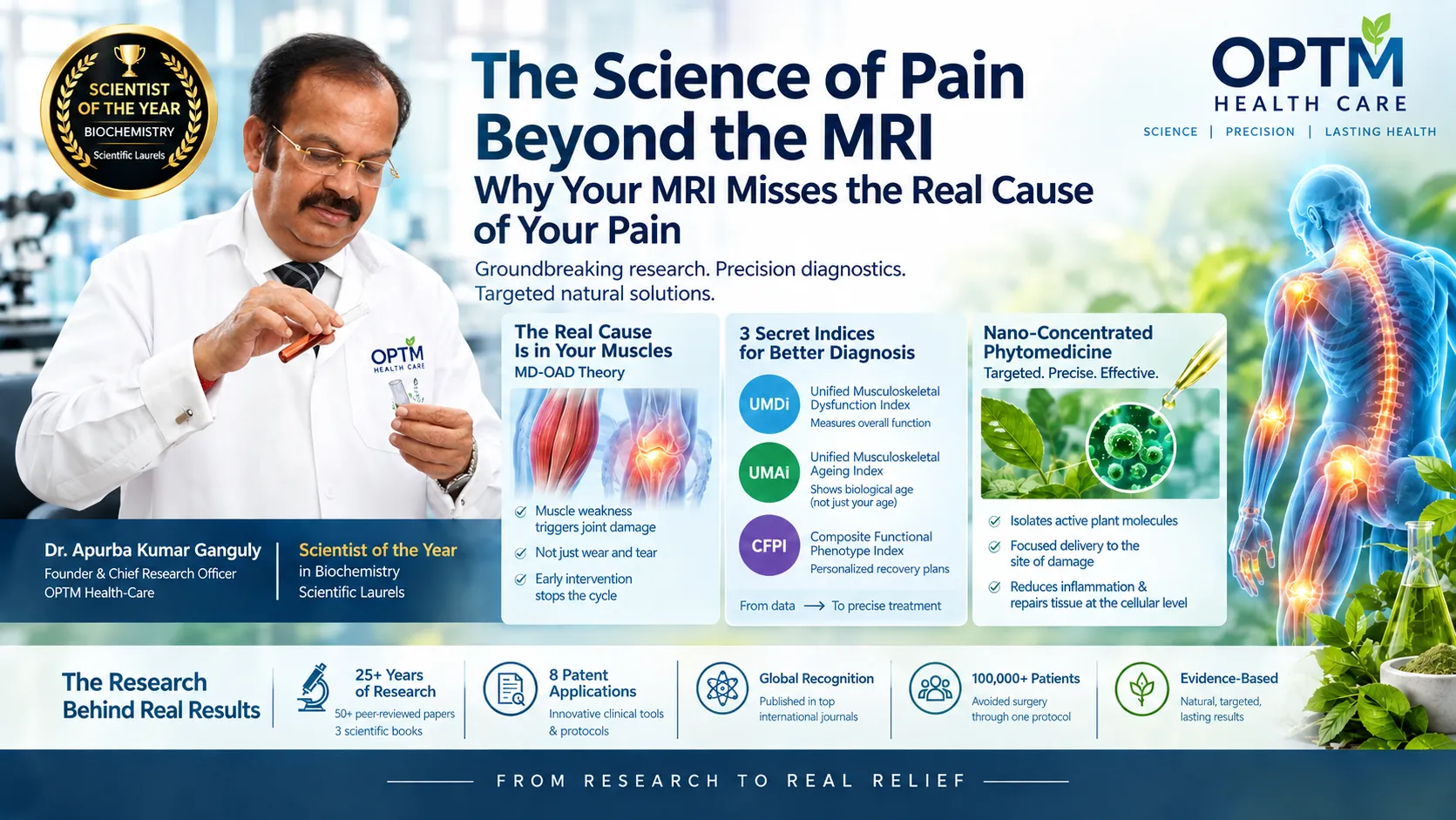
This is the diagnostic shift behind modern non-surgical pain care: from image- decisions to multi-layer assessment where structure, movement, and molecular signals are read together.
Why Imaging Alone Is Incomplete
Imaging is indispensable. Fractures, major deformity, disc herniation morphology, and implant planning all need pictures. Chronic degenerative pain, however, is often a biochemical story with a structural shadow.
Two patients can share a similar MRI and live completely different pain lives. One is cytokine-dominant with high IL-6 and CRP. Another shows elevated cartilage-turnover markers. A third has metabolic inflammation from insulin resistance layered onto mild radiographic OA. Treat all three with the same tablet schedule and you should not expect the same result.
- Imaging strength: location, severity grade, surgical anatomy.
- Imaging blind spot: active inflammatory driver, cartilage catabolism rate, systemic amplifiers.
- Biomarker strength: which pathway is currently driving tissue damage and pain.
- Combined model: structure + molecular map + movement assessment.
What OPTM's AI Biomarker Panel Actually Measures
The core panel is drawn from a single blood sample and interpreted by OPTM's AI engine alongside clinical context. Markers typically include inflammatory cytokines and acute-phase proteins (CRP, IL-6, IL-1β, TNF-α, ESR), cartilage matrix and protease signals (MMP-3, COMP), metabolic contributors (uric acid, Vitamin D 25-OH, Insulin/HOMA-IR), and additional enzymes such as Aldolase-A selected by presentation.
No single number "proves osteoarthritis." Patterns do. High IL-6 with rising MMP activity tells a different therapeutic story than isolated vitamin D deficiency with mild structural change. The AI's job is to rank the most likely primary driver so treatment is aimed at the dominant mechanism first.
| Diagnostic task | Standard imaging | OPTM AI biomarkers |
|---|---|---|
| Identify affected joint | Strong | Supportive with clinical exam |
| Identify primary metabolic driver | ~60% accuracy in validation task | 97% accuracy (n=1,240) |
| Guide phytomedicine targeting | Limited | Core strength |
| Track treatment response | Slow structural change | Repeat panels at day 21 & 42 |
How 97% Accuracy Was Framed
In OPTM's validation work (n=1,240 patients), AI biomarker analysis was compared with standard orthopaedic imaging for identifying the primary metabolic driver of joint degeneration — not for detecting whether a knee exists on film. On that task, AI reached 97% accuracy [Source] versus approximately 60% for imaging-led driver assignment.
The 37-point gap represents cases where imaging correctly flagged the painful joint but misidentified or missed the biochemical engine — leading to treatments that soothe symptoms while the driver continues. That is the practical meaning of precision diagnostics in chronic pain.
From Result Sheet to Treatment Protocol
A biomarker report is not a prescription by itself. OPTM clinicians translate the AI map into a phytomedicine and movement plan:
- Driver ranking: Which pathway is primary vs secondary.
- Compound selection: Standardised phytocompounds matched to inflammatory, catabolic, or metabolic targets.
- Load strategy: Movement correction that protects healing tissue without total deconditioning.
- Interval retesting: Day 21 and day 42 panels confirm biological response and trigger adjustments.
This closed loop is what separates "personalised at the first visit" marketing from genuinely adaptive care. If markers do not move, the plan changes. If they move and symptoms lag, rehabilitation emphasis can shift. Treatment becomes a measured process instead of a fixed package.
What Patients Experience at the Clinic
The initial diagnostic assessment is available at OPTM clinics in Delhi, Kolkata, and Panchkula for . After clinical evaluation and blood collection, AI interpretation is typically returned within 48 hours. Patients leave with a clearer map: not "you have OA," but which biological levers are most responsible for pain right now.
For patients outside primary cities, partner collection pathways may be available — blood still needs a proper draw, but interpretation remains centralised so standards do not fragment by location.
"Pain is a symptom. Biomarkers are a map. AI is how we read the map fast enough to treat the cause — not the complaint."
The Future of Pain Diagnosis Is Already Clinical
Global orthopaedics is moving toward precision phenotyping. Wearables, multi-omics, and AI imaging will all play roles. For chronic degenerative joint pain today, blood biomarkers already provide an actionable middle layer between "looks worn on X-ray" and "needs a replacement."
If you have tried physiotherapy, painkillers, or injections without durable relief, the missing piece may not be another modality — it may be a diagnosis that finally names the driver.
A Walkthrough: From Blood Draw to Personalised Plan
Patients often imagine AI diagnostics as a black box. In practice the pathway is concrete and time-bounded. Visit one captures history, functional limits, prior imaging, medication exposure, and the blood panel. Within about 48 hours, the AI returns a ranked driver profile — for example, cytokine-dominant inflammation with secondary vitamin D insufficiency, or cartilage-turnover elevation with metabolic insulin resistance.
The clinician then translates rank order into a protocol: which phytocompound intensities to prioritise, whether metabolic cofactors need concurrent correction, how aggressively to progress loading, and when to retest. Day 21 results show whether the primary driver is moving. Day 42 results confirm trajectory and inform maintenance planning. If markers stall while symptoms improve, the team investigates compliance, sleep, or unmeasured amplifiers rather than declaring victory prematurely.
Who benefits most from biomarker-first care
Biomarker testing is especially valuable when pain has outlasted standard care, when multiple joints are involved, when flares track seasons or stress, when imaging severity and symptom severity disagree, or when surgery has been proposed primarily on radiographic grounds. It is less about replacing MRI for structural questions and more about answering the question MRI cannot: which biological engine is currently destroying comfort and capacity.
Athletes use the same pathway to distinguish training overload inflammation from early degenerative chemistry. Desk professionals use it to separate pure mechanical postural strain from systemic inflammatory load. Older adults use it to avoid being funnelled into replacement solely because an X-ray looks advanced while treatable synovitis remains the louder pain source.
The assessment is deliberately positioned as an entry diagnostic, not a vague consultation fee. You are paying for a molecular map that can change the entire treatment tree — including the decision to wait on elective surgery while a non-surgical protocol is stress-tested against your own bloodwork.
Frequently Asked Questions
Q: Which biomarkers does OPTM analyse?
A: A 60+ marker panel including CRP, IL-6, IL-1β, TNF-α, MMP-3, COMP, Aldolase-A, ESR, uric acid, Vitamin D, Insulin/HOMA-IR, and presentation-specific additions.
Q: How does 97% accuracy compare with imaging?
A: For identifying the primary metabolic driver, AI biomarker analysis outperformed imaging-led assignment (97% vs ~60% in validation, n=1,240).
Q: Can testing be done remotely?
A: Collection is in person; AI analysis is centralised. Ask about partner collection centres if you are outside Delhi, Kolkata, or Panchkula.
Q: Will markers be retested during treatment?
A: Yes — typically around day 21 and day 42 — so protocols adapt to biochemical response.
Q: Is this the future of orthopaedics?
A: Precision, multi-layer diagnosis is the global direction. Biomarker-guided care is already in routine use at OPTM clinics.
Stop Guessing What Drives Your Pain
Book your AI biomarker diagnostic assessment today at OPTM clinics
Related Clinical Resources