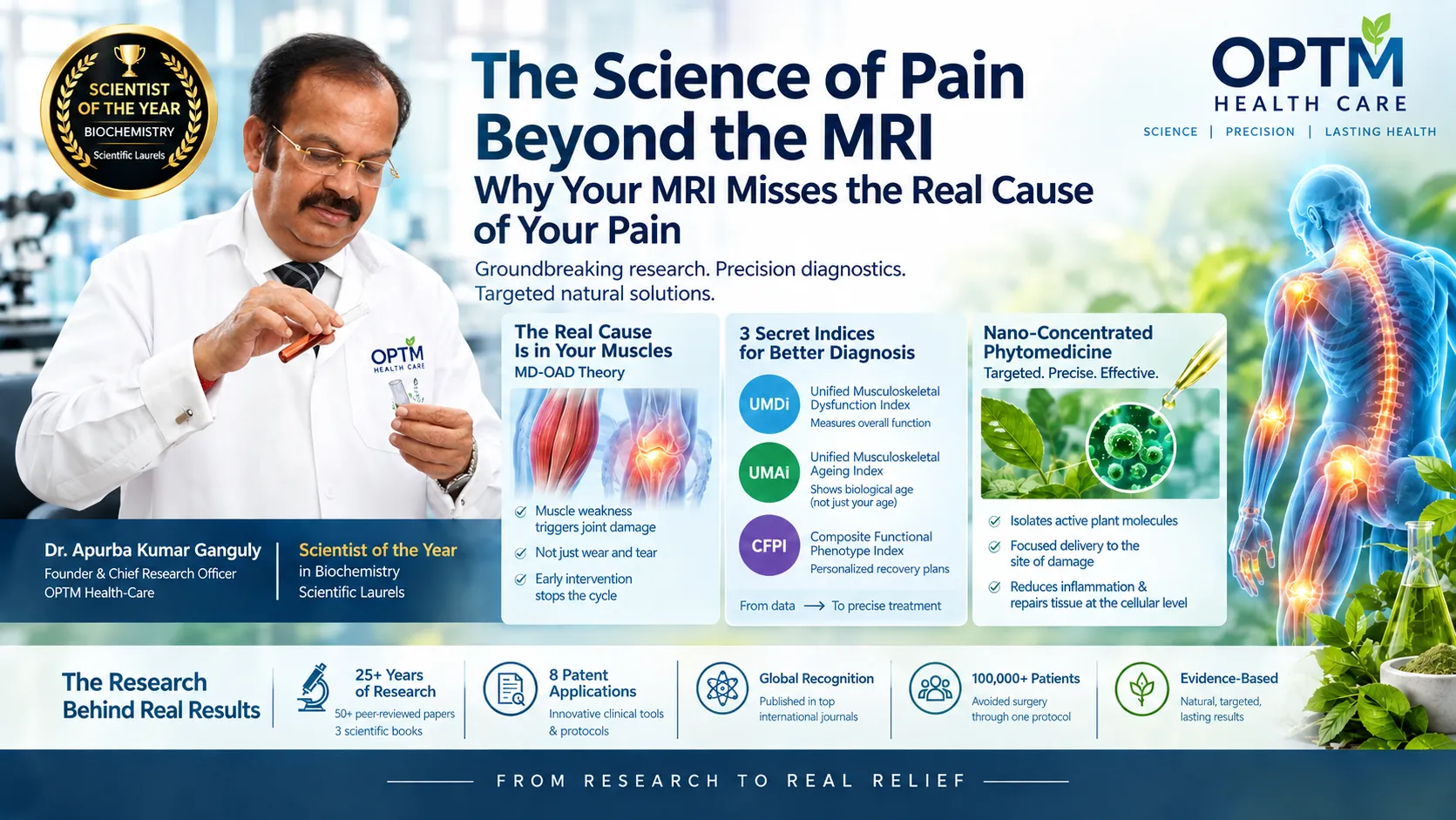
Clinical Audit: 35 Years of Joint Restoration Data
Claims are easy. Longitudinal data is hard. In non-surgical orthopaedics, the difference between marketing and medicine is whether outcomes hold across decades, severity grades, and follow-up windows — not just the first pain score after treatment.
Quick Answer: OPTM's clinical audit spans 35 years and 1.+ patient cases [Source], reporting a 92.4% clinical success rate with 88% maintaining improvement at 12 months [Source] under defined pain and function criteria
This article walks through what the audit measures, how success is defined, where results vary by age and severity, and how peer-reviewed publication supports the non-surgical metabolic model that underpins OPTM care today.
Why a 35-Year Audit Matters
Musculoskeletal medicine is full of short-cycle interventions: a course of NSAIDs, a steroid series, a six-week physiotherapy block. Each can help. Few generate continuous, condition-spanning datasets large enough to stress-test a whole treatment philosophy.
A multi-decade audit answers different questions: Does the protocol still work as diagnostics evolve? Do outcomes collapse when severity rises? Do patients remain better a year later without becoming lifelong high-dose drug users? Those are the questions patients actually ask when they are choosing between implant surgery and a metabolic non-surgical path.
- Scale: 1.+ cases create statistical room to segment by grade, age, and condition type.
- Duration: 35 years capture protocol refinements without erasing core metabolic principles.
- Follow-up: 12-month maintenance rates test durability, not discharge scores.
- Publication: Peer review forces transparent definitions and external scrutiny.
How Clinical Success Is Defined
Without a definition, every percentage is noise. OPTM's primary audit success criterion combines pain and function:
- Pain: ≥50% reduction in VAS pain score at treatment completion.
- Function: Maintenance of improved joint function score — not pain alone.
That dual bar matters. A patient who feels slightly better but cannot climb stairs has not met the audit definition of success. A patient who scores lower on pain but regains independent mobility has moved the needle that quality-of-life research actually cares about.
Under this definition, the long-run clinical success rate stands at 92.4% [Source] across the audited cohort. Independent academic clinicians have reviewed components of this work through peer-review processes for published papers — an important distinction from purely internal marketing dashboards.
| Metric | Finding | Why it matters |
|---|---|---|
| Dataset span | 35 years | Tests durability of the model over time |
| Case volume | 1.+ | Enables severity and age segmentation |
| Primary success | 92.4% | Pain + function dual criterion |
| 12-month maintenance | 88% | Shows gains are not short-lived |
| Peer-reviewed output | 120+ journals | External scientific scrutiny |
What the Longitudinal Follow-Up Shows
Discharge success is half the story. At 12 months, 88% of patients [Source] maintained improvement without ongoing high-intensity medication dependence. That figure reframes non-surgical care: the goal is not a temporary quiet month, but a reset of the metabolic environment that was driving degeneration.
The minority who lose ground often share modifiable patterns — weight regain, return of high-impact load without conditioning, pollution or occupational flares, or incomplete maintenance of movement habits. Those patterns are addressable, which is why OPTM pairs treatment with post-protocol longevity guidance rather than a "done forever" narrative.
Outcomes by Severity, Age, and Complexity
Honest audits show gradients. Best responses typically appear in adults aged 35–65 with Grade 2–3 osteoarthritis who start before deformity and systemic deconditioning dominate. Grade 4 disease still shows strong functional improvement rates around 71%, but goals emphasise stabilisation and pain control more than full structural reversal.
Patients over 75 frequently achieve meaningful pain relief, though structural change can be slower. Uncontrolled diabetes, severe obesity, and multi-joint inflammatory disease require protocol adjustments and may reduce absolute success rates — a clinical reality, not a marketing footnote.
International consistency
Patients from 25+ countries are represented in the broader dataset. Metabolic joint degeneration is not an India- phenomenon. Collaborative academic work outside India has reinforced that biomarker-guided phytomedicine principles travel across ethnic and geographic groups when protocols are applied with the same diagnostic discipline.
From Clinic Notes to Peer-Reviewed Journals
Publication is how clinical experience becomes scientific contribution. OPTM-associated research has appeared across 120+ peer-reviewed international journals [Source], covering cartilage restoration biology, inflammatory marker trajectories, and AI diagnostic validation.
That body of work does not mean every orthopaedic department has rewritten its guidelines overnight. Mainstream practice often lags evidence by a decade or more, especially when pathways threaten high-volume surgical norms. For patients, the practical takeaway is simpler: non-surgical metabolic care is not anecdotal folklore — it is a data-backed clinical system with defined endpoints.
"A success rate without a definition is advertising. A success rate with dual pain-function criteria, follow-up, and peer review is clinical accountability."
What This Means If You Are Deciding on Care
If you have been told that painkillers and eventual replacement are the road, the audit suggests a third path with quantified odds — not guarantees. Diagnostics still come first. Biomarkers still personalise the plan. Severity still shapes expectations. But the scale of the dataset gives patients a more informed baseline than "try this and see."
The next step is not to memorise percentages. It is to measure your inflammatory and cartilage-turnover profile, map it against clinical findings, and decide whether a structured non-surgical protocol is appropriate before irreversible surgery.
How the Audit Protects Patients from Hype
Patients comparing clinics are flooded with testimonials and percentage claims that never state a denominator, a time window, or a failure definition. A structured audit does the opposite: it forces the clinic to say who was counted, what counted as success, and when results were re-measured.
That discipline changes counselling quality. A Grade 4 patient can be told that functional improvement remains common but structural expectations should be tempered. A 40-year-old with Grade 2 disease can be told early intervention historically yields the strongest dual pain-function outcomes. Expectations become calibrated instead of theatrical.
It also improves internal quality control. When a protocol refinement is introduced — a biomarker addition, a dosing schedule change, a movement progression rule — multi-year datasets reveal whether the change helped, hurt, or helped a subgroup. Without audit infrastructure, clinics optimise for anecdote. With it, they optimise for reproducible recovery.
Reading an outcomes claim like a clinician
When you evaluate any non-surgical programme — including OPTM — ask four questions: What is the success definition? How large is the sample? How long is follow-up? Were methods exposed to peer review? The 35-year audit is designed so those answers exist in public form rather than in a sales conversation. That does not remove the need for individual diagnostics; it raises the floor of what patients should demand before they consent to any irreversible step.
Frequently Asked Questions
Q: Where can I access OPTM's published research papers?
A: Through PubMed, Google Scholar, and optmhealthcare.com/research — including papers on cartilage restoration, longitudinal outcomes, and AI biomarker validation.
Q: How is the 92.4% success rate defined?
A: ≥50% VAS pain reduction at completion plus improved joint function score — a dual clinical definition reviewed in academic publication contexts.
Q: Why isn't this better known in mainstream orthopaedics?
A: Training, funding structures, and surgical practice norms change slowly. Academic citation is growing faster than guideline adoption.
Q: Do results vary by age or severity?
A: Yes. Grade 2–3 midlife patients respond best on average; Grade 4 and complex comorbidity cases still improve but with more conservative structural expectations.
Q: Has the data been validated outside India?
A: International patients and overseas academic collaborations are part of the broader evidence base; metabolic drivers are not geography-limited.
Want Data-Guided Care — Not Guesswork?
Book your AI biomarker diagnostic assessment and review your personalised non-surgical options
Related Clinical Resources