Knee Pain Without Surgery in Kolkata: What Non-Surgical Therapy Actually Does
Your knee shouldn't decide whether you climb the stairs in your Ballygunge home or skip the walk to the Salt Lake market. But for a lot of people in Kolkata, that's exactly what's happening. And most of them have no idea there's a non-surgical path forward.
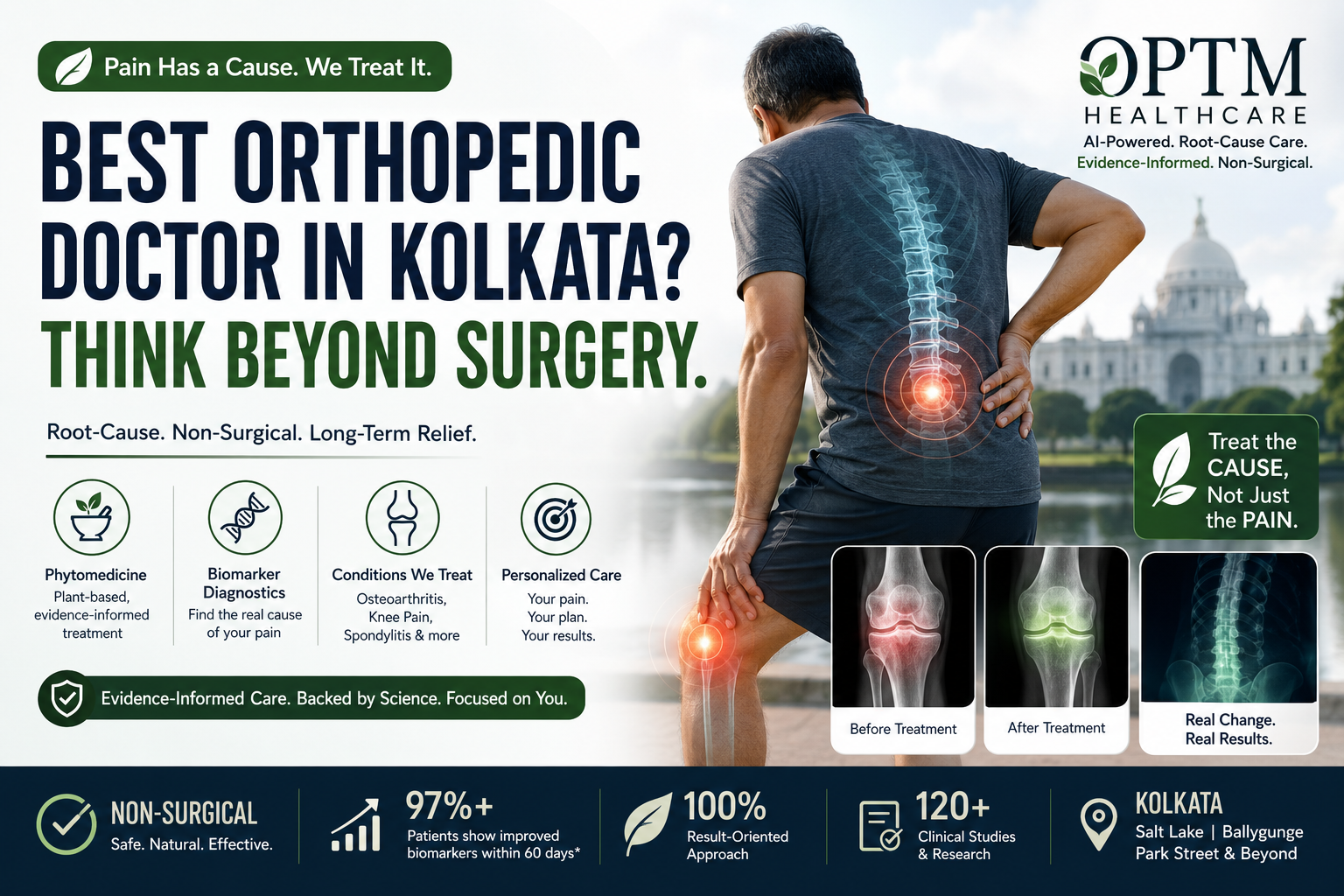
Quick Answer: OPTM Healthcare treats knee osteoarthritis with standardized phytomedicine — topical, plant-derived formulations aimed at cutting inflammation and supporting joint function — as an alternative to knee replacement surgery for people with mild-to-moderate osteoarthritis.
This guide is for anyone in Salt Lake, New Town, Ballygunge, Park Street, or Dum Dum who wants the real picture before committing to a treatment plan.
Here's the Problem With How Most Clinics Treat Knee Pain
Pop a pill. Get a shot. Repeat next month. That's the loop most knee pain treatment falls into — and it doesn't fix anything. It just buys a few pain-free days while the joint underneath keeps wearing down.
Kolkata doesn't make this easier. Humid air, concrete pavements, hours of daily commuting — your knees absorb all of it. So people reach for NSAIDs just to get through the day. The National Kidney Foundation has flagged the risks of long-term NSAID use, including damage to your gut and kidneys. Mask the pain without touching the cause, and the joint keeps deteriorating underneath the numbness.
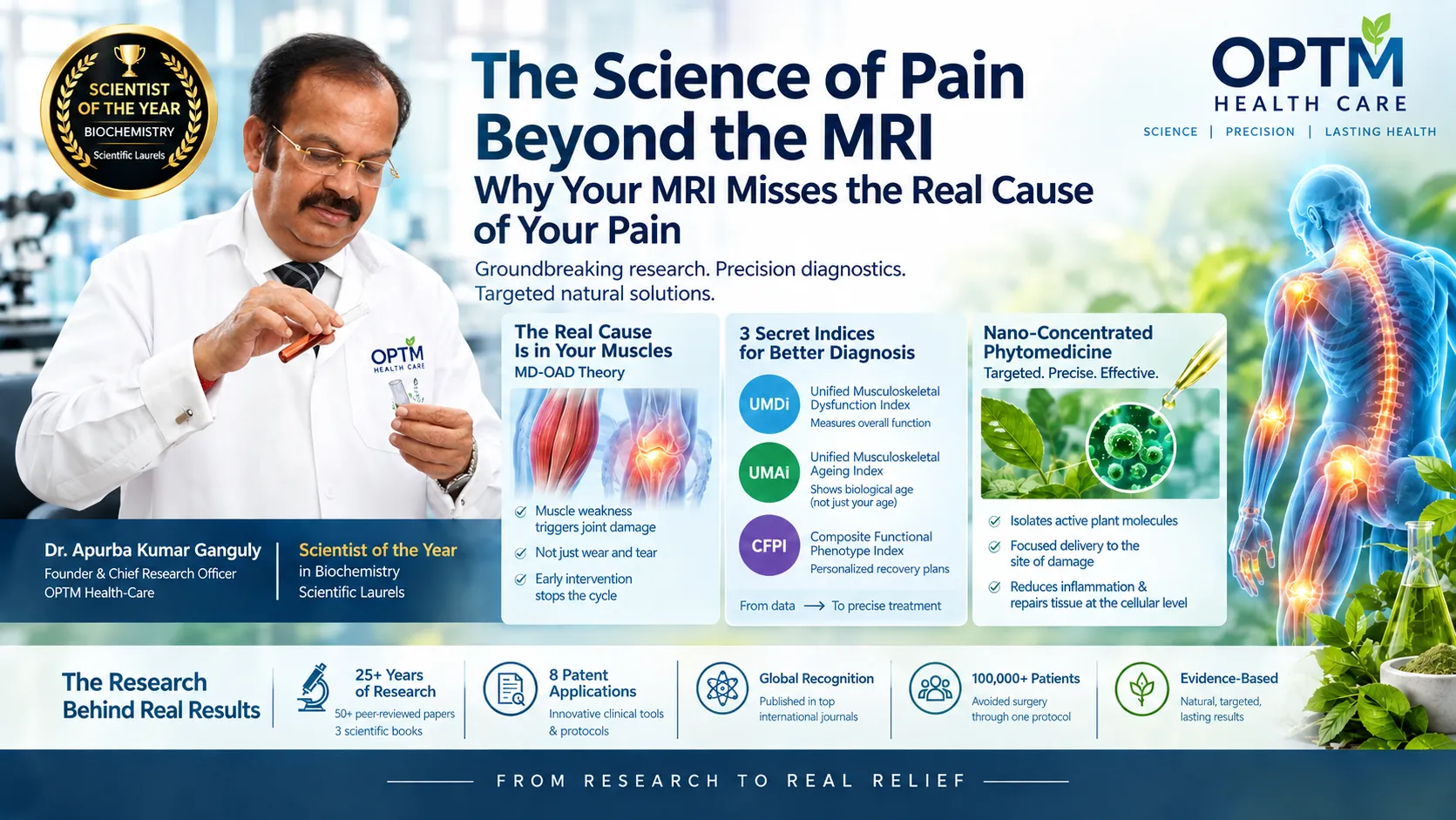
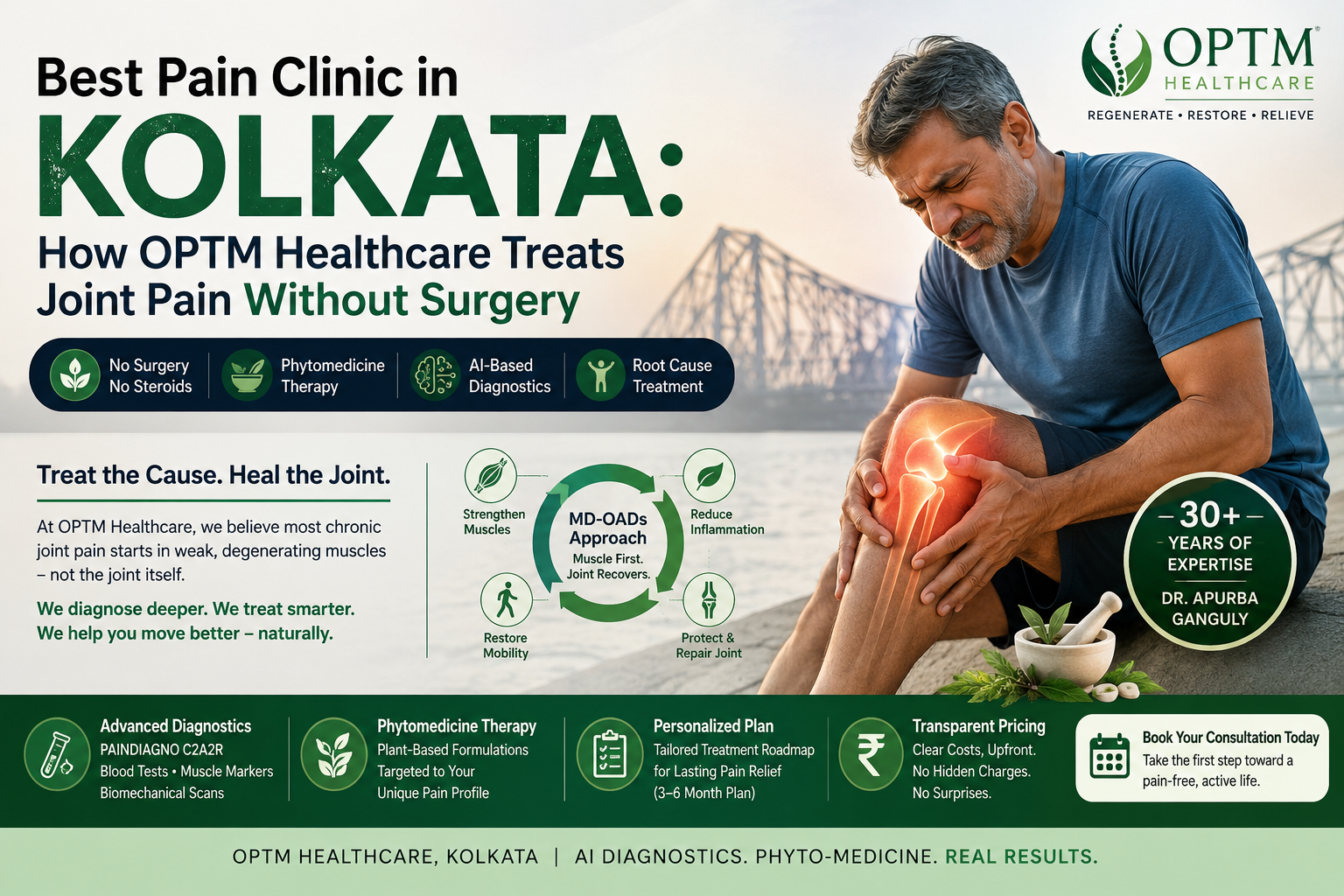
OPTM Healthcare looks at your knee as one connected system — muscle, ligament, cartilage, all dependent on each other. When one piece weakens, the rest compensates, and the whole joint suffers for it. Their phytomedicine protocol is applied directly to the joint, aiming to cut local inflammation and support the body's own repair process over the course of treatment.
"Try this: Count how many days this week you reached for a painkiller. More than twice? That's not treatment — that's a delay tactic, and it's worth asking whether your current plan is going anywhere."
What "Natural Treatment" Should Actually Mean
Not every natural remedy is built the same. A generic herbal oil rubbed on your knee at home is nothing like a standardized phytomedicine protocol with measured, consistent doses of active compounds.
The World Health Organization has stressed the need for safety and standardization across traditional medicine systems generally — a useful benchmark for evaluating any provider. OPTM Healthcare markets its own formulations as standardized, meaning each application is meant to deliver a consistent dose.
How Phytomedicine Actually Works
The idea is simple: specific plant-based compounds, applied directly to the joint, reduce local inflammation and support circulation — which may help the body repair cartilage and surrounding tissue on its own.
The National Institutes of Health has published research on anti-inflammatory and chondroprotective properties in various botanical extracts. OPTM applies its own proprietary blends topically, using techniques designed to improve absorption into the joint.
Now, the part most clinics won't tell you straight: OPTM has published its own case-based documentation — small case series showing patients who chose topical phytotherapy over revision surgery. That's real, and worth knowing about. If you want the full picture, ask your provider directly what evidence backs the specific protocol they're putting you on.
Non-Surgical Care in Salt Lake and New Town
If you live in Salt Lake or New Town, you don't need to cross the city for care. Sessions are built around your schedule — no overnight stays, no disappearing from work for weeks.
Set your expectations right: recovery from a degenerative condition doesn't happen overnight. Any clinic promising instant, guaranteed results for osteoarthritis should raise an eyebrow. Real improvement — with any treatment — takes weeks, not days.
What a Non-Surgical Treatment Journey Actually Looks Like
Most structured programs start with a baseline assessment, then move through defined phases over 6 to 12 weeks, checking progress as they go.
- Initial Diagnostic Mapping: Baseline numbers on range of motion, muscle bulk, and pain.
- Customized Phytomedicine Application: Topical formulations targeting local inflammation.
- Bio-Electromagnetic Therapy: Non-invasive pulses meant to support absorption.
- Gradual Rehabilitation: Low-impact movement to rebuild the muscles supporting the joint.
- Progress Evaluation: Regular re-measurement so the plan adjusts to what's actually happening.

The Mistakes That Set People Back
| Mistake | Why It Hurts You | What to Do Instead |
|---|---|---|
| Repeated steroid injections | Can accelerate cartilage loss over time. | Ask your doctor about non-injection alternatives. |
| Random herbal oils | No standardization means no consistency. | Ask exactly how a formulation is dosed. |
| Ignoring weak muscles | Weak support muscles dump more load onto the joint. | Pair treatment with guided strength work. |
| Delaying necessary surgery | Some cases genuinely need surgery. | Get an honest assessment before ruling anything out. |
Phytotherapy vs. Surgery vs. Standard Physiotherapy
There's no universal right answer. Knee replacement is still correct for extreme, end-stage bone-on-bone damage — full stop. But for mild-to-moderate osteoarthritis, non-surgical options can deliver real improvement with a lower risk profile than surgery, which carries its own risks: infection, blood clots, implant failure.
When Phytomedicine Isn't the Answer
Be honest about the limits. An acute ligament tear needing surgical reattachment, or a joint that's already fused — phytomedicine isn't built for that. It's designed for degenerative, wear-and-tear conditions, not structural emergencies.
What This Actually Costs You in Kolkata
Non-surgical outpatient therapy generally costs less than surgery — but the exact number depends on the clinic and plan.
- Weeks 1–2: Bring down acute inflammation and swelling.
- Weeks 4–8: Rebuild flexibility and mobility.
- Weeks 8–12: Strengthen the muscles holding the joint together long-term.
Frequently Asked Questions
Q: What's the typical outcome of non-surgical knee therapy?
A: It depends on the person and how advanced the damage already is. Many with mild-to-moderate osteoarthritis see less pain and better mobility over 6–12 weeks — but starting early and sticking to the plan matters more than anything else.
Q: How is phytomedicine different from regular Ayurveda?
A: OPTM markets its phytomedicine as clinically standardized — measured doses, consistent formulation, absorption techniques built in. Traditional Ayurvedic oils and massages are usually far less standardized.
Q: Is this safe for elderly patients with diabetes or hypertension?
A: Topical, non-invasive treatment is generally lower-risk since it skips oral medication interactions altogether. Confirm with your physician before starting anything new.
Q: How many sessions am I actually looking at?
A: Most programs run 24–36 sessions over roughly 12 weeks. That number moves depending on your case, so get a specific estimate from your provider.
Book the Assessment
Get a full joint assessment at OPTM Healthcare's Salt Lake, New Town, or Ballygunge clinics.
Related Clinical Resources