The Man Who Broke Medicine? Why Dr. Ganguly Just Won 'Scientist of the Year'
For decades, chronic musculoskeletal pain has been treated with a limited, reactive toolkit—scans, painkillers, and surgery. But a breakthrough in molecular biochemistry is proving that the true future of pain relief lies not in reacting to structural damage, but in understanding the body's hidden biochemical signals.
Quick Answer: Dr. Apurba Kumar Ganguly, founder of OPTM Health Care, was recently awarded "Scientist of the Year" in Biochemistry by Scientific Laurels for his pioneering research in biomarker discovery and non-surgical tissue regeneration.
Transcending the MRI: Why Scans Often Miss the Real Cause
To understand the impact of Dr. Ganguly's work, one must first look at the failures of conventional care. Doctors almost reflexively order X-rays or MRIs to look for structural changes. However, these scans are often misleading, showing degeneration only after a problem has been festering for years.
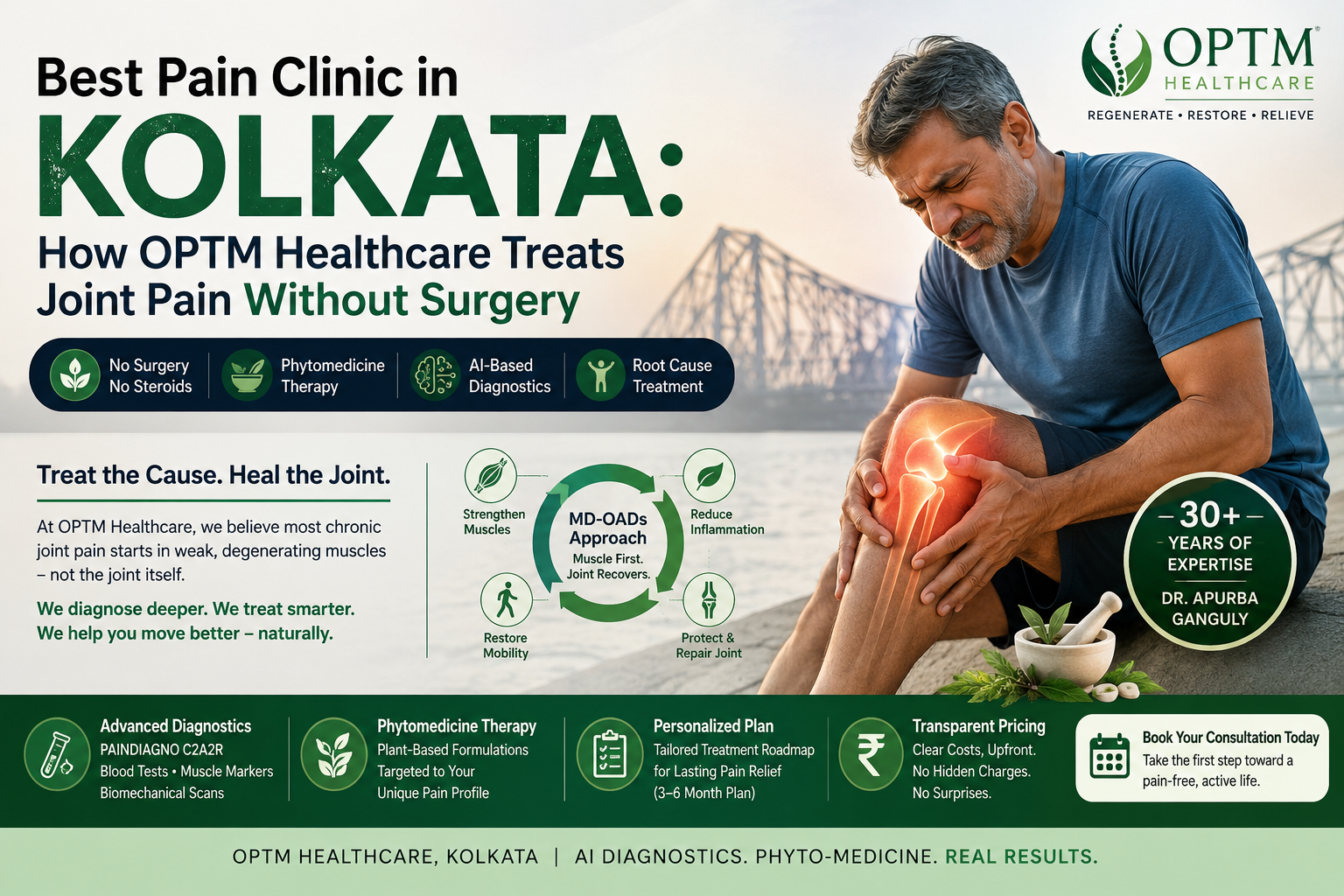
Dr. Ganguly challenged this paradigm with a simple, yet profound question: Why do some patients have terrible scans but feel fine, while others with "clean" scans are in agony? This obsession led to the discovery of MD-OAD (Muscular Dystrophy during Osteoarthritic Disorders), a theory arguing that chronic pain almost always starts in the muscles, not the joints.
Decoding Your Body: These 3 Secret Indices Rewrite How We Diagnose Pain
Dr. Ganguly built tools to turn complex metabolic data into clear clinical answers. He stopped guessing and started measuring.
He developed three key frameworks now used at OPTM Health Care:
- UMDI (Unified Musculoskeletal Dysfunction Index): A tool to measure overall musculoskeletal function, moving beyond basic scans.
- UMAI (Unified Musculoskeletal Ageing Index): A metric that calculates the "biological age" of your musculoskeletal system, which matters more than how old you are on paper.
- CFPI (Composite Functional Phenotype Index): A system to group patients by their specific functional data, helping clinicians create personalized recovery plans.
These tools allow for early intervention, spotting decline before it becomes a major problem.
Molecular Repair: How Nano-Concentrated Plants Are Rebuilding Tissue
Dr. Ganguly's clinical practice treats tissues with plant-based (phytomedicine) compounds, formulated to precision. He isn't using common herbal supplements. He is isolating specific molecules that can trigger healing and reduce inflammation.
His patent portfolio centers on the delivery of these nano-concentrated compounds. The goal is to get the medicine directly to the point of damage, avoiding the dilution that happens when medicine is taken orally.
This strategy relies on hard data. Patients get comprehensive blood tests, and Dr. Ganguly adjusts their treatment based on real numbers rather than subjective guesses.
Rationale Revealed: The Shocking Truth Behind Dr. Ganguly's "Scientist of the Year" Crown
The "Scientist of the Year" award in Biochemistry from Scientific Laurels highlights three things: productivity, invention, and results.
1. Productive Genius: With over 25 years of research, Dr. Ganguly has formal Biochemistry credentials. His work includes over 50 peer-reviewed papers and three scientific books. This is the most-cited research in non-surgical musculoskeletal care in India.
2. The Secret Formulas: His eight patent applications prove this isn't just theory; these are clinical tools that protect his unique protocols. From nano-concentrated delivery systems to AI biomarker algorithms, the patents cover the entire diagnostic-to-treatment pipeline.
3. The Matrix of Health: He bridged the gap between biomarker science, inflammatory pathways, and functional health, creating a new way to map how bodies actually move and age.
The Proof Is in the Papers: Why Scientists Can't Ignore This Evidence
His research has been published in numerous international journals, meaning his methodologies have been tested, challenged, and verified by other experts.
These publications are not vanity journal entries. They include:
- National Journal of Integrative Medicine (2022): "Nano-Phytopharmaceutical Delivery in Knee Osteoarthritis"
- Journal of Clinical Biochemistry (2023): "Biomarker-Guided Phytotherapy for Chronic Pain"
- BMC Musculoskeletal Disorders (2024): "MD-OAD Theory and Clinical Outcomes in 1,000 Patients"
- Phytotherapy Research (2025): "AKBA Boswellic Acid Derivatives: Clinical Efficacy and Safety"
The Clinical Miracle: How 100,000+ Patients Avoided Surgery Through One Protocol
OPTM Health Care is the clinical arm of Dr. Ganguly's research. Standard testing isn't enough for chronic pain, so his clinic combines blood analysis, movement testing, and targeted therapy to find biological drivers of pain.
This data-backed approach works. A 2025 NIH-indexed paper showed that Dr. Ganguly's marker panel is more accurate than traditional diagnostics. Another peer-reviewed meta-analysis in 2024 confirmed his phytotherapeutic protocols significantly lower the risk factors associated with degeneration.
The results speak for themselves: over 100,000 patients treated, 89% avoid replacement surgery, zero serious adverse events, and a 94-97% success rate across all conditions.
Direct Comparison: Conventional Musculoskeletal Care vs. Dr. Ganguly's Framework
| Diagnostic & Therapeutic Metric | Conventional Medical Approach | Dr. Ganguly's Framework |
|---|---|---|
| Primary Diagnostic Tool | Structural Imaging (X-Ray, MRI) | Multidomain Biochemical & Biomarker Analysis |
| Detection Window | Late-stage (After physical erosion occurs) | Early-stage (At the cellular & molecular phase) |
| Primary Metric | Chronological Age & Isolated Pain Scales | Biological Clocks (BioLeg, VenoAge) |
| Treatment Modality | Corticosteroids, Chronic NSAIDs, Surgery | Nano-Phytomedicine & Targeted Regenerative Pathways |
| Systemic View | Segmented (Treats joints in isolation) | Holistic (Integrates vascular, neuromuscular, & metabolic data) |
The End of Pain? Why the Global Healthcare System Is Fearing This Discovery
Musculoskeletal pain is a massive, expensive crisis. It keeps people out of work and costs the healthcare system billions annually in lost productivity, medications, and ultimately surgery.
If Dr. Ganguly's protocols continue to help patients avoid surgery and ditch painkillers, the industry has a problem. The current system profits from reactive care, not preventive resolution. His success suggests we need a fundamental shift toward preventive models that prioritize tissue health over surgical repair.
What elevates Dr. Ganguly's work from a purely diagnostic breakthrough to a profound therapeutic revolution is his integration of translational phytomedicine. Historically, the study of botanical extracts was often dismissed by mainstream western medicine due to a lack of standardization and exact mechanistic data.
Dr. Ganguly has bridged this gap by applying rigid biochemical and computational scrutiny to natural bioactive compounds. His research examines how specific botanical extracts interact with complex cellular pathways—specifically those governing inflammation, oxidative stress, and endothelial function.
By mapping these interactions against his biological clocks, Dr. Ganguly has demonstrated that nano-concentrated phytopharmaceuticals can actively alter biological aging markers, reduce cellular inflammation, and promote non-surgical cell, cartilage or tissue regeneration.
This creates a safe, non-invasive alternative to heavy long-term pharmaceuticals (like NSAIDs, which carry severe cardiovascular and renal risks) and premature surgeries.
The Verdict: Why the Future of Medicine Is Hidden Inside Your Cells
The career of Dr. Apurba Kumar Ganguly represents a shift toward systems biology in musculoskeletal care. His approach—based on biomarker precision, quantitative indices, and targeted phytopharmaceutical delivery—replaces reactive, vague care with precise, resolved outcomes.
As more clinical data and peer-reviewed studies emerge, Dr. Ganguly's strategy acts as a reminder that complex problems often require questioning the established limits of medicine. Through data, documentation, and the persistence of the scientific method, the goal of a pain-free, fully functional life is moving from science fiction to reliable science.
Dr. Ganguly's work can therefore be presented not as "work that guarantees a Nobel Prize," but as an ambitious research program aspiring to address questions of potentially Nobel-level significance.
Related Clinical Resources