The OPTM Protocol: Non-Surgical Joint Care, Written From Your Blood
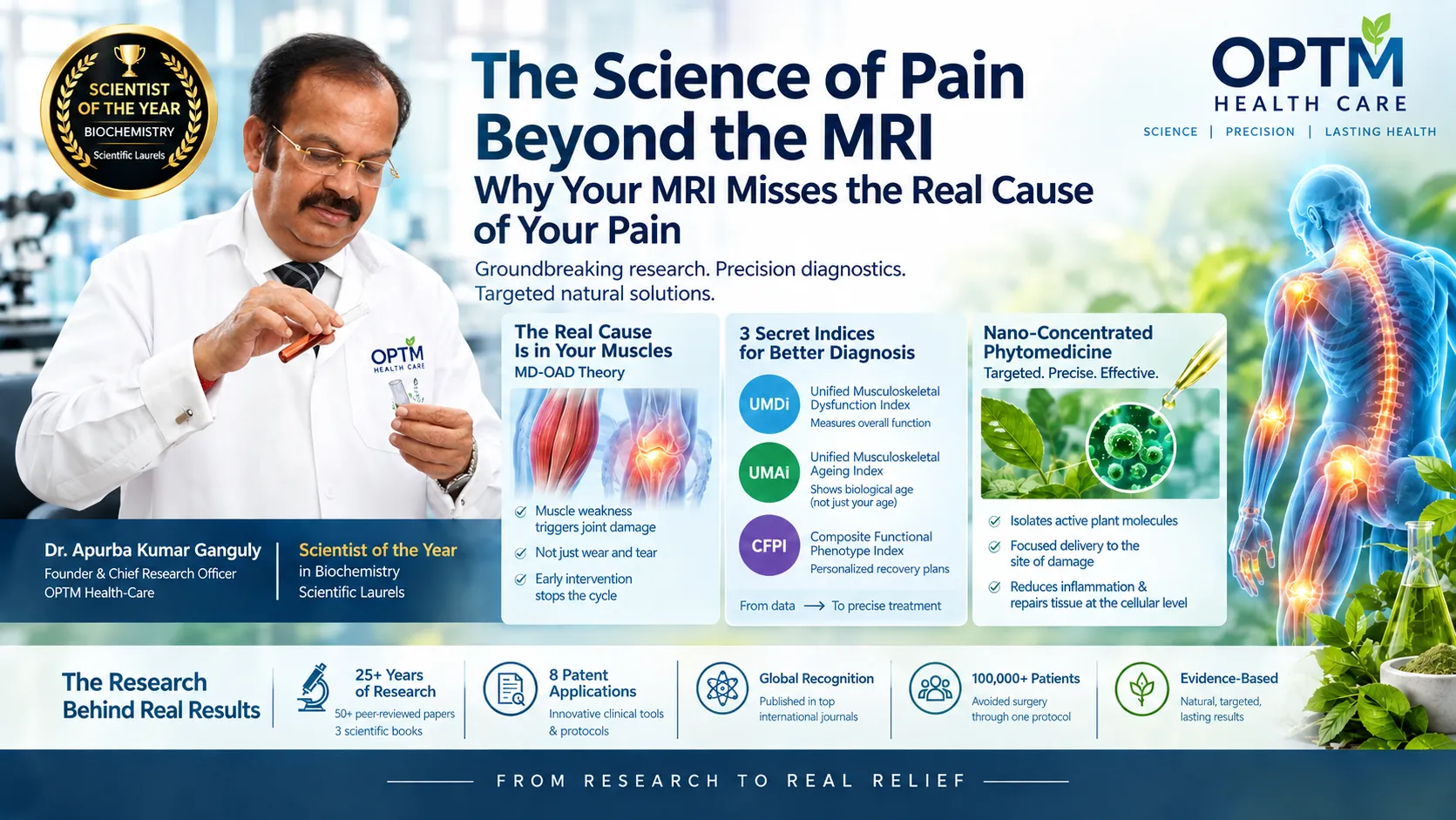
An X-ray can show that your joint space has narrowed. It cannot show why your cartilage is dissolving at that rate — or which inflammatory pathway will respond to which therapy. That missing "why" is why millions of patients cycle through painkillers, physiotherapy, and injections with temporary relief.
Quick Answer: OPTM's AI pain diagnosis analyses multi-marker blood biomarker panels to identify metabolic drivers of joint degeneration with 97% diagnostic accuracy [Source] — far beyond structural imaging alone — so phytotherapy protocols can be precision-matched to each patient
This is the diagnostic backbone of OPTM's permanent, non-surgical joint restoration philosophy: measure the chemistry, then treat the chemistry — while clinical scientists remain accountable for every protocol decision.
The Diagnostic Gap in Conventional Orthopaedics
Standard musculoskeletal care is structurally brilliant and metabolically blind. Imaging answers: Where is the damage? How large is the tear or osteophyte? It does not answer: Which cytokines are driving progression? Is muscle metabolic failure unloading the joint incorrectly? Is systemic inflammation from metabolic syndrome pouring fuel on a local fire?
- X-ray: Bone contours, joint-space width, alignment — static structure.
- MRI: Soft tissue detail — still little metabolic context.
- Routine bloods: Often limited to CRP/ESR if ordered at all — under-interpreted for musculoskeletal precision.
- Trial-and-error treatment: NSAID → physio → steroid → surgery pipeline without molecular targeting.
When diagnosis is incomplete, treatment becomes generic. Generic treatment fails complex disease. That is the cycle AI biomarker diagnostics is built to break.
Consider two patients with identical "moderate medial OA" reports. Patient A has sky-high IL-6, poor sleep, and visceral adiposity driving systemic inflammation. Patient B has near-normal cytokines but profound quadriceps metabolic failure and valgus collapse on stairs. Same radiology code; opposite treatment priorities. Without multi-marker AI pattern recognition, both receive the same generic NSAID-and-walk-advice package — and both are told they "failed conservative care" when that care never matched their biology.
OPTM built its diagnostic stack specifically for this heterogeneity. The AI does not invent a disease label to replace clinical examination; it ranks which molecular drivers best explain the patient's trajectory so phytotherapy and movement plans stop being one-size-fits-all.
What OPTM's AI Actually Analyses
The platform evaluates a broad biomarker set — inflammatory cytokines, cartilage degradation enzymes, muscle enzymes, metabolic and nutritional cofactors — commonly described as 60+ core biomarkers within a wider 60+ panel context depending on case complexity. Patterns, not single numbers, drive insight.
Examples of clinically meaningful signals
- CRP and IL-6: Systemic inflammatory tone linked to OA progression and multi-joint flares.
- MMP-related markers: Cartilage matrix breakdown activity.
- Muscle enzymes (e.g., aldolase patterns): Peri-articular muscle metabolic stress that destabilises joints.
- Metabolic cofactors: Vitamin D and related markers that influence musculoskeletal recovery capacity.
Machine learning compares your pattern against a large longitudinal clinical library — on the order of 100,000+ treated patient trajectories [Source] in OPTM's historical experience — to generate ranked hypotheses about drivers and treatment priorities.
97% Accuracy: What That Number Means (and Does Not)
| Modality | What it reveals | Typical limitation | Role at OPTM |
|---|---|---|---|
| X-ray / MRI alone | Structure | Misses metabolic drivers | Essential context |
| Standard CRP/ESR | Crude inflammation | Non-specific; weak protocol design | Included but insufficient alone |
| OPTM AI multi-marker panel | Driver pathways + pattern match | Requires blood draw + expert review | Primary precision layer (97% [Source]) |
Accuracy here means the system's ability to correctly identify clinically actionable diagnostic patterns compared with expert-validated outcomes in OPTM's methodology — not a claim that computers replace doctors. Every AI-generated recommendation is reviewed by a senior clinical scientist before a protocol starts.
"AI provides precision and speed. The clinical scientist provides judgment and accountability. Together they outperform either alone."
From Diagnosis to Personalised Non-Surgical Protocol
- initial assessment pathway: Registration, head-to-toe clinical evaluation, and diagnostic planning as structured at clinic.
- Biomarker panel draw: Blood collection at Delhi, Kolkata, or Panchkula; results commonly return within about 48 hours.
- AI pattern analysis + clinician confirmation: Hypotheses become a signed treatment plan.
- Phytotherapy + movement correction: Compounds and load plans matched to your dominant pathways.
- Re-testing checkpoints: Markers rechecked (commonly around day 21 and day 42) to verify trajectory and adjust.
Precision diagnosis enables precision treatment — which underpins programme-level outcomes such as 89% surgery avoidance [Source] in selected candidates and high patient-reported recovery rates when protocols are completed.
Does AI Replace Imaging?
No. Biomarkers and imaging are complementary. MRI still measures disc protrusion size; X-ray still grades joint-space loss. AI adds the metabolic dimension: why damage is progressing and which biochemical interventions are most likely to slow or reverse that progression. Optimal plans use both lenses.
Who Benefits Most From AI Biomarker Diagnosis
- Chronic knee, spine, or multi-joint pain not explained fully by "wear and tear" stories
- Patients with identical imaging grades but divergent symptom severity
- People failed by NSAIDs, physiotherapy, or injections who need a new diagnostic frame
- Surgical candidates seeking an evidence-based non-surgical trial first
- Patients with environmental or occupational amplifiers (pollution, monsoon, desk load, sports overload)
If your care plan has never measured more than a basic ESR, you have been treated with partial information. Partial information produces partial results.
Privacy, Clinical Oversight, and What Patients Experience
Patients sometimes worry that "AI diagnosis" means a black-box app on a phone. In practice, the experience is a structured clinic visit: history, examination, informed blood draw, and a report discussion with a human clinician who can explain why certain pathways were prioritised. You should leave understanding which markers were high, what that implies for cartilage or muscle, and how the first phase of phytotherapy will try to move those numbers.
Data are used to improve pattern recognition across the clinical library, but treatment decisions remain individual. The permanent path to joint restoration is not a gadget — it is a disciplined loop of measure, treat, re-measure until the chemistry that was destroying the joint is no longer in charge.
Availability Across OPTM Clinics
Full AI diagnostic capability is available in Delhi, Kolkata (Gariahat), and Panchkula (Sector 11). Blood draws occur on-site; analysis is processed through OPTM's diagnostic system. Remote follow-up can be arranged after an initial in-person assessment when travel is limited.
Frequently Asked Questions
Q: What exactly does the initial assessment include?
A: The initial assessment pathway includes head-to-toe checkup and diagnosis components, consultation, and registration fees as structured by the clinic — the entry point into biomarker-guided care planning.
Q: How is AI being used — is a computer making my diagnosis?
A: The AI engine interprets biomarker patterns against large historical case libraries to generate hypotheses and protocol suggestions. Senior clinical scientists review and confirm all diagnoses before treatment begins. AI supplies precision; clinicians supply judgment.
Q: Can I request this test from my own doctor?
A: The full OPTM biomarker panel and AI analysis is proprietary to OPTM's system and is not available as a standard package through routine pathology labs. Existing labs (CRP, ESR, uric acid, vitamin D) can be incorporated, but a full panel is required for AI-generated protocol recommendations.
Q: Does biomarker testing replace X-rays and MRIs?
A: It complements them. Imaging shows structure; biomarkers show metabolic drivers and treatment targets. Both inform optimal protocol design.
Q: Is the AI diagnostic platform available at all OPTM clinics?
A: Yes — Delhi, Kolkata, and Panchkula. Blood can be drawn at any clinic; results are typically processed centrally and returned within about 48 hours.
Book the Assessment
Book your AI biomarker diagnostic assessment pathway available
Related Clinical Resources