Sports Injuries in Chandigarh: Treatment at OPTM Panchkula Without Cortisone First
Chandigarh's fitness culture is enviable — lake runs at Sukhna, bootcamps in Sector parks, padel and badminton leagues, cycling groups that treat the Tricity like a training ground. The downside is predictable: overuse injuries, weekend-warrior meniscus flares, and a quiet epidemic of cortisone dependence among people who still want to train hard.
Quick Answer: Tricity athletes and fitness enthusiasts can treat many exercise-induced injuries naturally with OPTM's Panchkula protocol — AI biomarker diagnostics plus sports-specific phytotherapy that reduces cellular inflammation without masking pain the way cortisone does
OPTM's Panchkula clinic (Sector 11) sits at the centre of this active population — serving Chandigarh, Panchkula, and Zirakpur patients who want to return to training without trading long-term cartilage health for a short pain holiday.
The Tricity Injury Profile: High Intensity, Incomplete Recovery
Sports injuries in Chandigarh and Panchkula rarely look like professional team-medicine cases. They look like:
- Runner's knee and IT-band overload from sudden mileage jumps on concrete.
- Patellar tendinopathy in badminton and volleyball athletes who train through pain.
- Rotator cuff irritation from gym pressing without scapular control.
- Early knee OA after old ACL or meniscus injuries now flaring at age 35–50.
- Low-back and SI joint pain from heavy lifting with poor bracing under fatigue.
The common thread is not lack of effort — it is recovery debt. High-intensity culture plus insufficient sleep, protein, and deload weeks creates a biochemical environment where microtrauma never fully resolves. Inflammation becomes chronic; performance drops; injections enter the picture.
The weekend-warrior pattern
A large Tricity subgroup sits at a desk Monday to Friday, then hammers high-intensity intervals, long runs, or tournament badminton on Saturday. Tissues that were stiff and under-loaded all week suddenly receive peak eccentric demand. Without progressive loading and mobility work mid-week, the result is predictable: calf-Achilles irritation, patellar tendon pain, and medial knee flares that "come out of nowhere" on Sunday evening.
Natural treatment for this pattern must fix both the acute inflammatory chemistry and the weekly loading schedule. Phytotherapy without load redesign is incomplete; rest without chemistry correction simply resets the clock until the next tournament.
Why Cortisone Is a Trap for Active People
Cortisone can feel miraculous for 2–6 weeks. For athletes, that temporary window is seductive — until the third or fourth shot. Steroids suppress inflammation signalling, but repeated intra-articular use is associated with accelerated cartilage volume loss. You feel better while the joint's structural reserve shrinks.
| Factor | Repeated cortisone injections | OPTM sports protocol |
|---|---|---|
| Primary effect | Rapid local symptom suppression | Systemic + local inflammatory pathway normalisation |
| Pain signals | Often masked | Reduced as biochemistry improves; protective signals preserved |
| Cartilage impact | Risk of accelerated breakdown with repeats | Supports chondrocyte-friendly environment |
| Return-to-train logic | Often premature full loading | Load management guided by markers + function |
| Durability | Short; flares return | Designed for lasting recovery windows |
"Pain is information. Silencing it with steroids without fixing the chemistry is how chronic injuries are born from acute ones."
How Natural Sports Injury Treatment Works at OPTM
Step 1 — Emergency or priority AI assessment
For acute exercise-induced injuries, we prioritise biomarker and clinical assessment so phytotherapy can begin quickly — often within 24 hours of contact when clinically appropriate. Markers help distinguish pure mechanical overload from systemic inflammatory amplification.
Step 2 — Sports-specific phytotherapy
Pharmaceutical-grade plant compounds target cytokine and oxidative pathways that keep soft tissue in a failed-healing state. This is not a generic "sports recovery juice." Dosing and combinations are calibrated to injury type: tendon-dominant, cartilage-dominant, or muscle-enzyme-dominant patterns.
Step 3 — Strategic load management (not forced rest)
Complete rest is rarely the best plan for athletes. We prescribe modified training that protects the injured tissue while maintaining cardiovascular fitness and contralateral strength. Movement correction addresses the technique faults that caused the overload.
Step 4 — Return-to-train criteria
Return is based on function and inflammatory trajectory — not calendar dates alone. Many athletes resume fuller training faster than with passive physiotherapy alone because the biochemical bottleneck is addressed first. Clinic experience commonly sees return-to-full-training windows around three weeks for selected soft-tissue cases, versus six to eight weeks with conventional rest-plus-physio pathways — individual results vary by injury severity.
Who This Protocol Is For
- Fitness enthusiasts with recurring knee, shoulder, or back pain after workouts.
- Amateur athletes facing season-limiting tendinopathy or early OA.
- Patients after 2–4 cortisone shots who want a cartilage-sparing alternative.
- Desk-to-gym hybrids whose stiff thoracic spine and weak glutes drive knee valgus under load.
- Post-injury athletes stuck on a plateau after conventional physiotherapy.
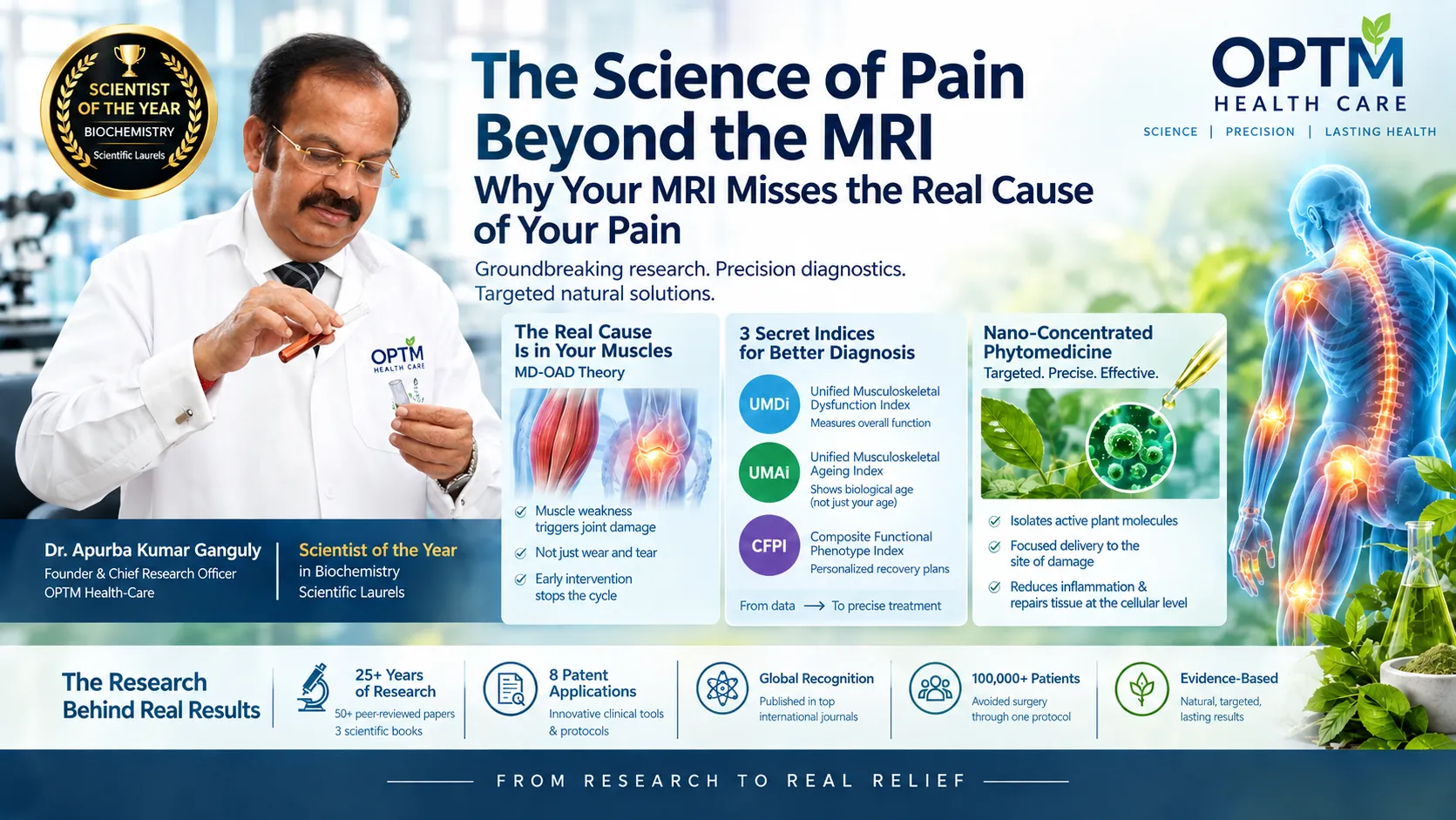
Diagnostic precision matters: OPTM's AI-supported biomarker interpretation reports 97% diagnostic accuracy [Source] in distinguishing metabolic contributors that imaging alone misses — critical when two runners with identical MRI labels respond differently to the same physio plan.
Phytotherapy + Physiotherapy: Complementary, Not Competing
Physiotherapy excels at mechanics: strength, range, motor control. OPTM addresses biochemistry first — reducing the inflammatory and metabolic drag that keeps tissue irritable — then layers movement work on a quieter joint. Starting with mechanics alone while cytokines remain high is why some athletes plateau for months.
Across the wider OPTM network in Delhi, Kolkata, and Panchkula, non-surgical musculoskeletal programmes continue to show strong functional outcomes and 89% surgery avoidance [Source] among selected candidates when protocols are completed.
Sample Recovery Roadmap for a Tricity Athlete
- Day 0–1: Clinical exam, injury history, biomarker draw, interim load plan (what you may still train).
- Day 2–3: AI-supported interpretation reviewed by clinician; phytotherapy initiated.
- Week 1–2: Inflammation downtrend; protected mobility and contralateral strength; technique fixes begin.
- Week 3: Progressive sport-specific drills if markers and pain rules allow.
- Week 4–6: Return-to-train criteria check; maintenance phytotherapy if residual risk remains.
Individual timelines vary with tendon versus cartilage dominance, age, sleep, and prior steroid exposure. The point of a roadmap is not false precision — it is replacing the vague instruction "rest and see" with measurable gates.
Visit OPTM Panchkula
Clinic address: 1003, Sector 11, Panchkula – 134109. Contact: +91-99886-23407. Centrally located for Chandigarh and Zirakpur athletes who want diagnostics and natural recovery without defaulting to another injection cycle.
If your identity includes being active — and pain is rewriting that identity — you do not have to choose between "tough it out" and "shut it down with steroids." There is a third path grounded in measurable biology.
Frequently Asked Questions
Q: Can OPTM treat acute sports injuries, or chronic conditions?
A: Both. The protocol covers acute exercise-induced injuries (ligament stress, muscle tears, inflammation), chronic overuse (runner's knee, tennis elbow, rotator cuff degeneration), and post-injury plateaus. Acute cases can begin with priority assessment and phytotherapy when clinically appropriate.
Q: I have had three cortisone injections. Can OPTM still help?
A: Yes. Repeated cortisone can reduce cartilage volume over time, but joints retain regenerative potential when the biochemical environment improves. AI assessment quantifies current status; protocols are designed to counteract steroid-related loss. Many patients after 2–4 injections still achieve strong 42-day outcomes.
Q: Will I have to stop training completely during treatment?
A: Not necessarily. Training recommendations are customised by injury type, severity, and markers. Many athletes continue modified training. Complete rest is rarely prescribed — strategic load management is.
Q: How does OPTM compare to physiotherapy for sports injuries?
A: Physiotherapy primarily addresses mechanics. OPTM addresses biochemical inflammation and cellular recovery first, then layers movement correction. They are complementary; starting with biochemistry often produces faster, more durable returns to sport.
Q: Where is the OPTM Panchkula clinic located?
A: 1003, Sector 11, Panchkula – 134109. Phone +91-99886-23407. Serves athletes and patients across the Tricity including Chandigarh and Zirakpur.
Book the Assessment
Book your Panchkula sports assessment — return to training without another cortisone cycle
Related Clinical Resources