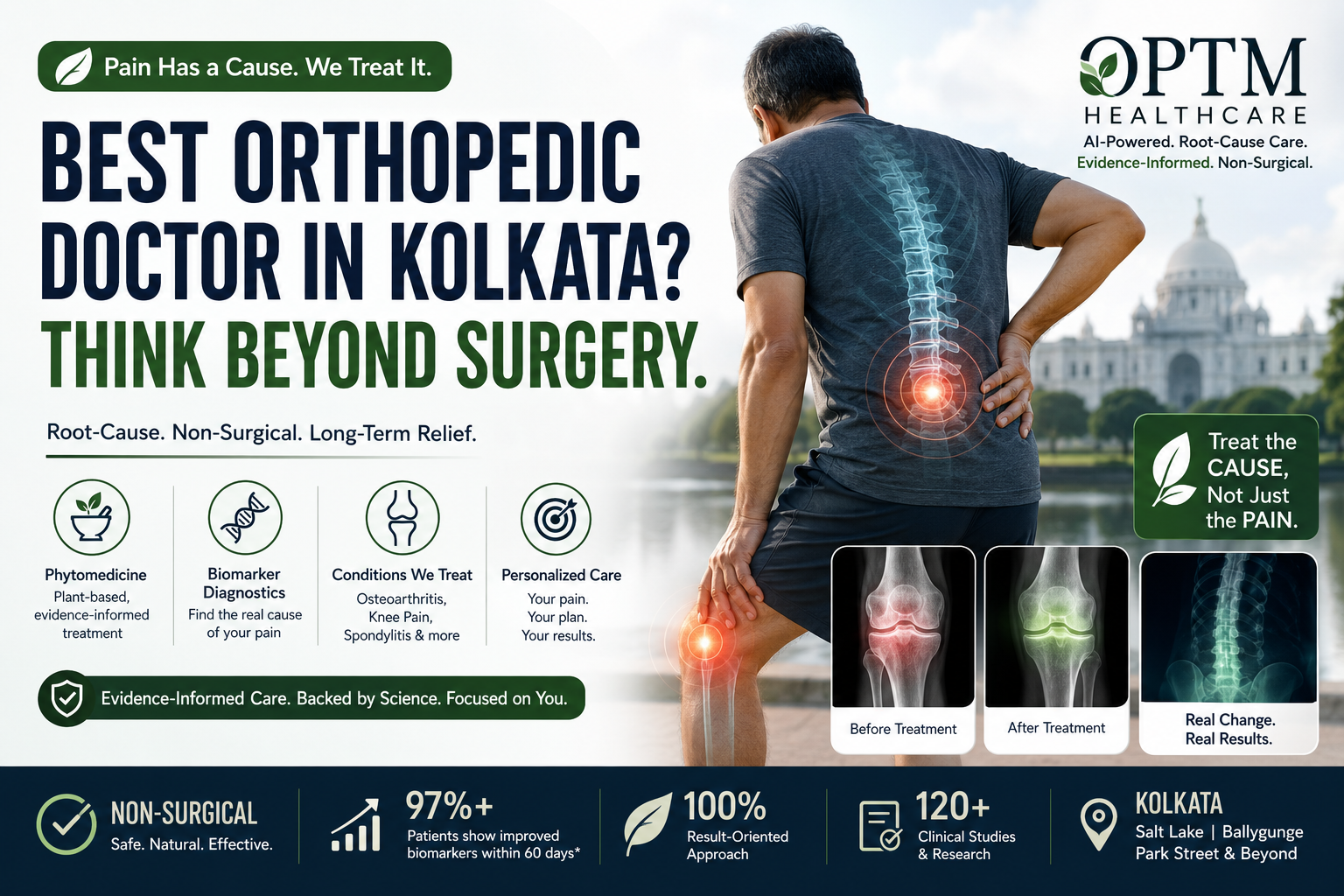
Natural Pain Relief Without Surgery: What Phytotherapy in India Actually Is
“Natural pain relief” has been diluted by supplement aisles and miracle claims. The real shift in India is quieter and more rigorous: pharmaceutical-grade phytotherapy guided by laboratory truth — not hashtags.
Quick Answer: Natural pain relief without surgery at OPTM means biomarker-guided, standardised phytomedicine that targets inflammatory and degenerative pathways — delivering clinical outcomes such as 89% surgery avoidance [Source] for suitable patients without scalpels or long-term steroid dependence
Redefining “Natural” in Clinical Terms
Aspirin began as willow bark chemistry. Modern phytomedicine continues that lineage with quantification: known active fractions, batch consistency, and dosing tied to measurable disease activity. If a product cannot state what molecule, at what strength, for which pathway, it is marketing — not medicine.
How Phytotherapy Relieves Pain Without Surgery
- Cytokine modulation: Dial down IL-1β / IL-6 / TNF-α signalling that keeps joints hot.
- Enzyme restraint: Reduce MMP-driven matrix destruction.
- Oxidative balance: Limit free-radical injury to cartilage and muscle.
- Chondrocyte support: Improve the cellular environment for matrix maintenance.
- Muscle recovery support: Address breakdown patterns that destabilise joints.
Surgery replaces geometry. Phytotherapy, when indicated, changes the biochemical weather system that made geometry fail.
Evidence Posture: What Patients Should Demand
| Criterion | Generic “herbal” products | OPTM clinical phytomedicine |
|---|---|---|
| Standardisation | Often unclear | Defined active concentrations |
| Diagnostics first | Rare | AI multi-marker mapping |
| Personalisation | One SKU fits all | Pathway-matched protocols |
| Monitoring | None | Retest markers & function |
| Goal | Symptom story | Measurable disease modification |
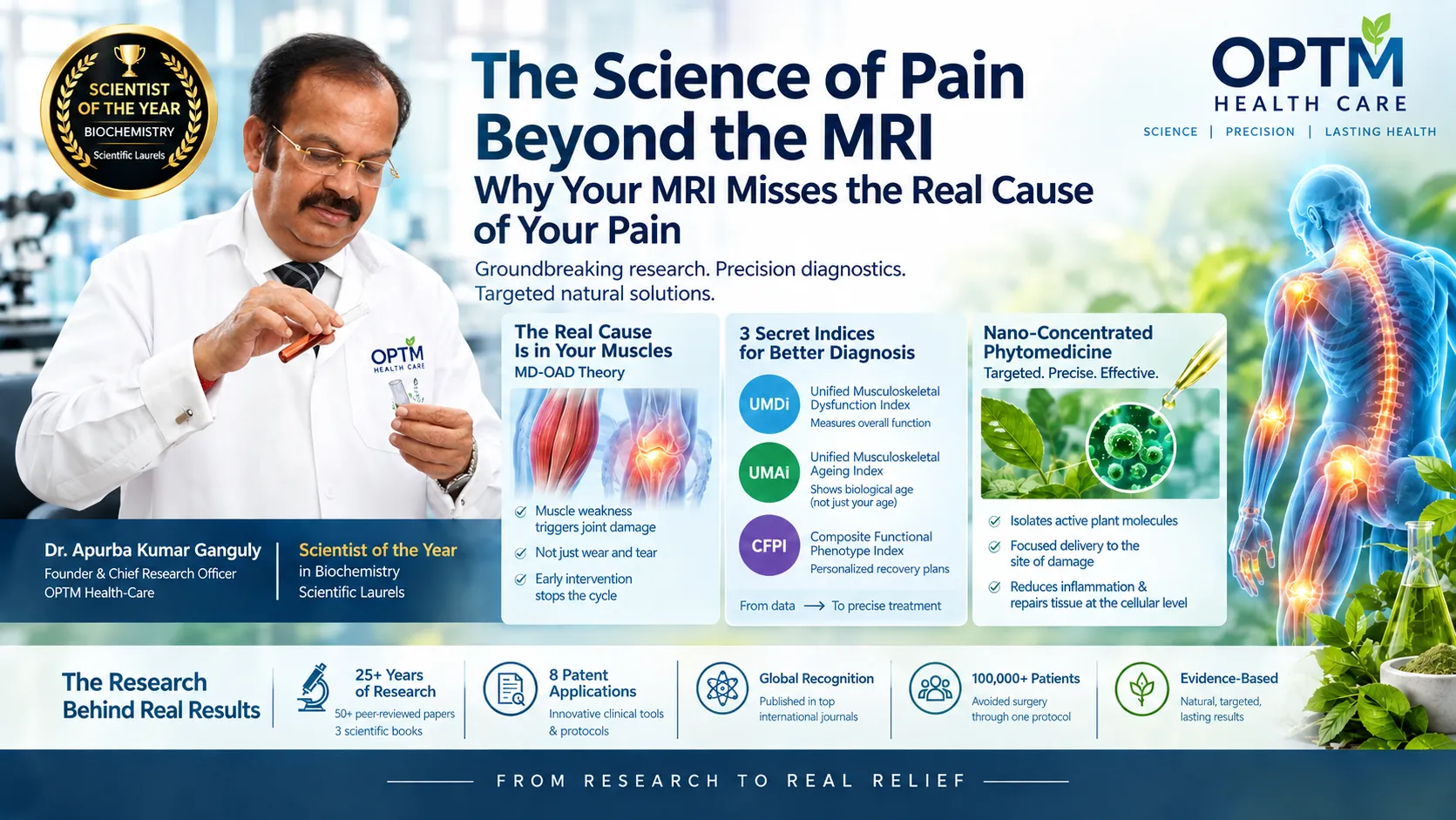
OPTM’s multi-decade practice spans 100,000+ patients [Source], with diagnostic accuracy claims of 97% [Source] for root-cause identification methodology and high satisfaction (94%+ [Source]) among completing patients.
Conditions Commonly Managed Without the Knife
- Knee and hip osteoarthritis (especially Grades 1–3; selective Grade 4 goals).
- Sciatica and disc-related radicular pain without emergency neurology.
- Cervical spondylosis and chronic neck–shoulder syndromes.
- Frozen shoulder and peri-articular inflammatory stiffness.
- Multi-site chronic pain with metabolic inflammatory drivers.
A Realistic Timeline for Natural Relief
Weeks 1–2: Inflammatory load begins to fall; night pain and stiffness often ease first.
Weeks 3–6: Function expands — walking tolerance, sit-to-stand ease, reduced guarding.
Beyond: Maintenance prevents the classic rebound that follows short steroid holidays.
This is slower than an injection’s theatre of relief — and more durable when chemistry actually changes.
Integrating Movement, Sleep, and Metabolic Health
Phytomedicine is not a permission slip to ignore load management. Sleep debt, central obesity, and uncontrolled glycaemia stoke the same cytokines protocols try to quiet. OPTM counselling ties compounds to practical habits so biology is not fighting lifestyle 16 hours a day.
Where to Access Clinical Phytotherapy
OPTM clinics in Delhi (South Extension), Kolkata (Gariahat), and Panchkula (Sector 11) deliver the same diagnostics-first model. Start with the assessment — not a cart full of untested bottles.
What “Relief” Should Mean Beyond a Lower Pain Score
A three-point drop on a pain scale matters. So does stair confidence, uninterrupted sleep, reduced fear of travel, and fewer emergency medicine top-ups. OPTM protocols track function because natural relief that numbs awareness without restoring capacity is another treadmill wearing green packaging.
Patients should ask: Can I walk farther? Is morning stiffness shorter? Are biomarker trends improving? If the metric is “I feel okay when I take the capsule,” you may still be in symptom mode — even with plant origins. Clinical phytotherapy aims for disease-modifying signals: quieter cytokines, calmer enzymes, stronger peri-articular muscle, and sustainable habits.
Stacking Therapies Without Stacking Confusion
- Phytomedicine + physio: Chemistry plus capacity — usually synergistic.
- Phytomedicine + abrupt marathon training: Common self-sabotage.
- Phytomedicine + undisclosed polypharmacy: Interaction risk — always disclose.
- Phytomedicine + endless steroid boosters: Mixed messages to cartilage biology.
Natural does not mean “combine everything sold online.” It means choose a coherent stack under clinical oversight. Delhi, Kolkata, and Panchkula teams write that stack after the map — not before.
India’s Moment: Precision Botanicals Meet Chronic Disease Burden
India carries enormous osteoarthritis and spine-pain burden amid variable access to quality rehab and high out-of-pocket surgical costs. A scalable non-surgical layer that is standardised, measurable, and culturally compatible is not optional innovation — it is public-health pragmatism. OPTM’s multi-decade dataset (100,000+ patients [Source]), surgery-avoidance framing (89% [Source]), and AI diagnostic layer (97% [Source]) sit inside that national need.
The phytotherapy shift succeeds if patients demand evidence the way they demand imaging. Ask for standardisation, ask for retesting, ask for contraindications. When natural care meets those standards, surgery becomes a specialist tool again — not the default chapter after the first bad monsoon of knee pain.
Safety Boundaries: Who Needs Conventional Care First
Natural protocols are powerful within scope. They are not first-line for open fractures, hot septic joints, acute cauda equina, or unstable trauma. Feverish joints, sudden foot drop, or cancer history with new destructive pain need urgent conventional pathways. OPTM clinicians triage these boundaries because ethical non-surgical care includes knowing when not to be non-surgical.
For the much larger group with degenerative and inflammatory chronic pain, pharmaceutical-grade phytotherapy plus markers is a primary strategy — not a consolation prize after theatre lists fill. That cultural shift is the heart of the phytotherapy shift in India.
Measuring Success Without Fooling Yourself
- Minutes of morning stiffness.
- Medicine breakthrough doses per week.
- Repeat inflammatory or pathway markers at protocol points.
- One meaningful life task (market walk, puja standing, play with grandchildren).
If four of five improve, you are succeeding even if a residual ache remains. Perfect zero pain is a marketing fantasy; restored life is a clinical goal. OPTM’s 94%+ [Source] satisfaction framing reflects that broader definition of relief — chemistry improved, function returned, surgery avoided when appropriate (89% [Source]), across a base of 100,000+ patients [Source] organisationally.
Frequently Asked Questions
Q: Can I take phytomedicine with my current medicines?
A: Often yes after clinician review. Never combine new compounds with prescriptions without disclosure — interaction checks are part of responsible care.
Q: Is natural care strong enough for severe pain?
A: Severe pain frequently has a large inflammatory component. Many high-pain patients improve substantially; emergencies and unstable structures still need conventional acute pathways.
Q: How is this different from physiotherapy alone?
A: Physio rebuilds capacity; phytomedicine changes chemical drivers. Combined, they outperform either as a lonely strategy for chronic inflammatory degeneration.
Q: Will I relapse after stopping?
A: Some patients need maintenance dosing or lifestyle scaffolding. Marker-guided tapering beats abrupt stop-start cycles.
Q: How do I begin?
A: Call +91 33 63 or book online for assessment at your nearest OPTM clinic.
Book the Assessment
Book your AI biomarker diagnostic assessment today
Related Clinical Resources